

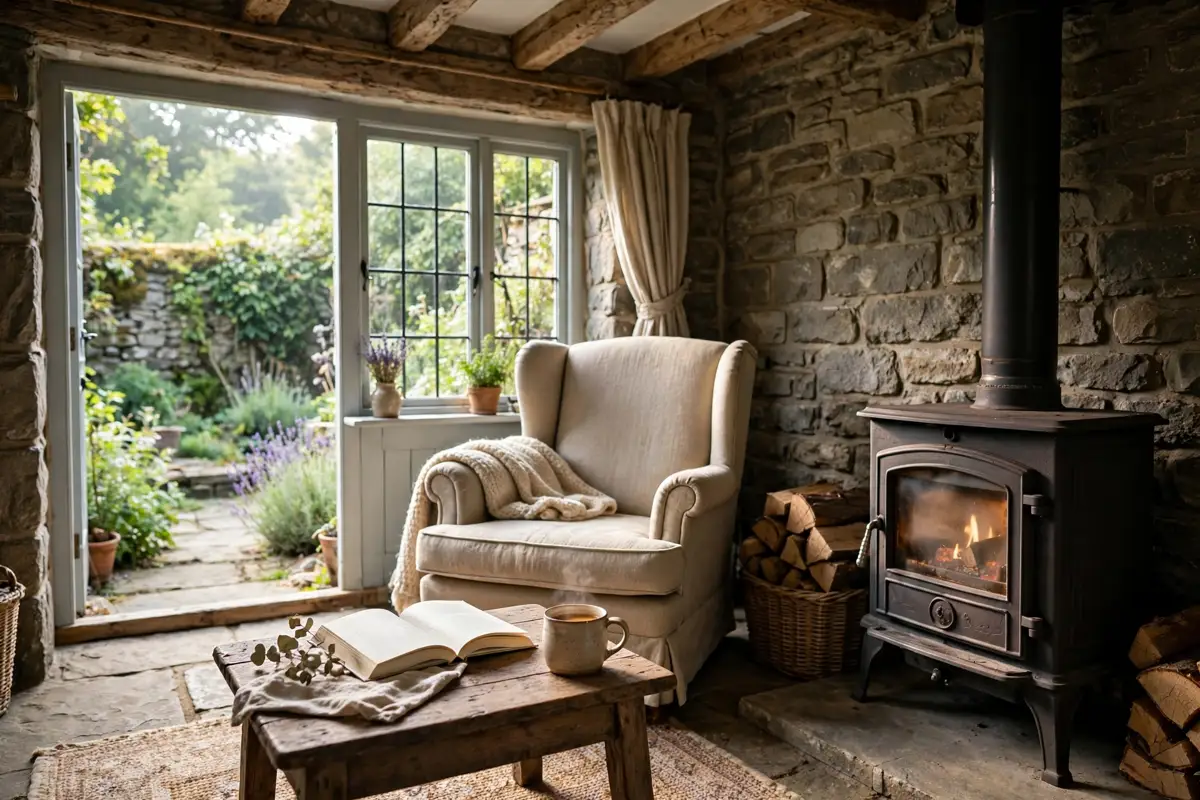
Most of us arrive on holiday already tired, carrying a phone full of notifications and a head full of unfinished lists. A relaxing cottage break offers something a busy hotel holiday rarely does: permission to slow right down. There is no timetable, no breakfast queue and no entertainment team with a microphone. There is just a comfortable cottage, the countryside outside the door and time that belongs to you again. This guide is about making the most of that time — not by planning more, but by planning less, deliberately.
Why a Cottage Break Relaxes You Differently
A cottage gives you a home-from-home rhythm from the first evening. You cook when you feel like it, eat when you are hungry and settle into a sofa that feels like your own. That familiarity matters: our minds rest more deeply in places that ask nothing of us. Unlike a resort, where the days are shaped around excursions and set mealtimes, a cottage stay lets the day find its own shape. For many guests, the most restorative part of a slow travel approach is discovering that an unplanned afternoon is not a wasted one — it is often the point of the trip. There is also the simple matter of space: a cottage has rooms to drift between, a garden to sit in and a door you can close on the world, which is a very different kind of rest from a single hotel room, however luxurious.
Choosing a Cottage That Suits Rest
Not every cottage lends itself to doing nothing. If relaxation is the goal, look for the features that make staying in a pleasure rather than a compromise: a comfortable sofa you would happily spend an afternoon on, a wood-burning stove or open fire for the evenings, a bath deep enough for a long soak and a garden or terrace that catches the sun. A well-equipped kitchen matters too, because slow cooking is part of the holiday. Location plays its part — a cottage at the end of a lane, with walks from the door and a pub within strolling distance, removes the need to drive anywhere at all. Read recent guest reviews with rest in mind: words like “peaceful”, “cosy” and “we barely left” are exactly what you are hoping to find.
Arrive Slowly and Unpack Properly
The first evening sets the tone. Resist the urge to dash out and “make the most of it” straight away. Unpack your bags fully, put the kettle on and take a short wander around the cottage and garden so the place feels familiar. Cook something simple, light a fire if there is one, and let the journey fall away. Travellers who rush the first evening often spend the whole break catching up with themselves; those who start gently usually feel settled by the second morning. If you have driven a long way, an early night is not a waste of a holiday evening — it is an investment in every day that follows.
Build Days Around Almost Nothing
The secret of a genuinely relaxing cottage break is a very light framework: one gentle anchor per day, and no more. That might be a morning walk to a viewpoint, a long lunch in a village pub, or an hour in the garden with a book. Around that single anchor, leave the hours open. Read, nap, watch the weather change, wander without a destination. If you are used to packed itineraries — the kind our guides to a holiday to Hawaii from the UK or a big touring trip help you organise — this will feel strange at first. Give it a day. Boredom, in small doses, is where rest actually begins, and many guests say the afternoon they planned least becomes the one they talk about when they get home.
Food, Sleep and the Small Rituals
Rest is physical as much as mental. Plan a few slow breakfasts with good local bread, eggs and coffee rather than rushing out. Keep one evening for a proper home-cooked meal using produce from a farm shop or market — cooking unhurriedly is itself a pleasure on holiday. Protect your sleep, too: cottages tend to be quiet and dark in a way city homes are not, so let yourself keep country hours, rising with the light and winding down early. Small rituals — a morning mug of tea outside, an evening stroll at dusk — give the days a gentle rhythm that your body remembers long after you are home. Even the washing up feels different when there is nowhere else you need to be.
Wet Afternoons and Slow Evenings
British weather will, at some point, have its say — and on a cottage break that is no bad thing. A rainy afternoon is an invitation, not an interruption: run a bath in the middle of the day, work through a jigsaw, bake something, or finally start the novel that has been sitting by your bed at home for months. Cottages usually come with a shelf of books and games left by previous guests, and there is a particular pleasure in reading a book you would never have chosen. In the evening, cook slowly, eat at the table rather than the sofa, and let the night draw in without filling it. Some of the deepest rest comes from evenings with nothing in them at all.
A Gentle Digital Detox
You do not need to banish your phone entirely, but a relaxing cottage break is the perfect chance to loosen its grip. Turn off notifications, leave the phone in a drawer during meals, and swap the evening scroll for a fire, a film or a board game. Many guests find the first day twitchy and the third day liberating. If work emails genuinely cannot wait, give them one fixed slot in the morning and close the laptop with intent — half-working all day is the enemy of rest, wherever you are. You may be surprised how quickly the urge to check fades when there is a garden, a view and a kettle instead.
Take the Calm Home With You
The best cottage breaks send you home with more than photographs. Notice which parts of the slow rhythm you loved — the unhurried breakfast, the daily walk, the phone-free evening — and steal one of them for ordinary life. A Sunday morning kept deliberately empty, or a weekly walk without headphones, keeps a little of the holiday alive. And when the tank runs low again, you will know the remedy: another few days of doing very little, very well — whether that is a cottage in the hills or a longer escape like the holidays to Bali our readers dream about for winter sun.
