


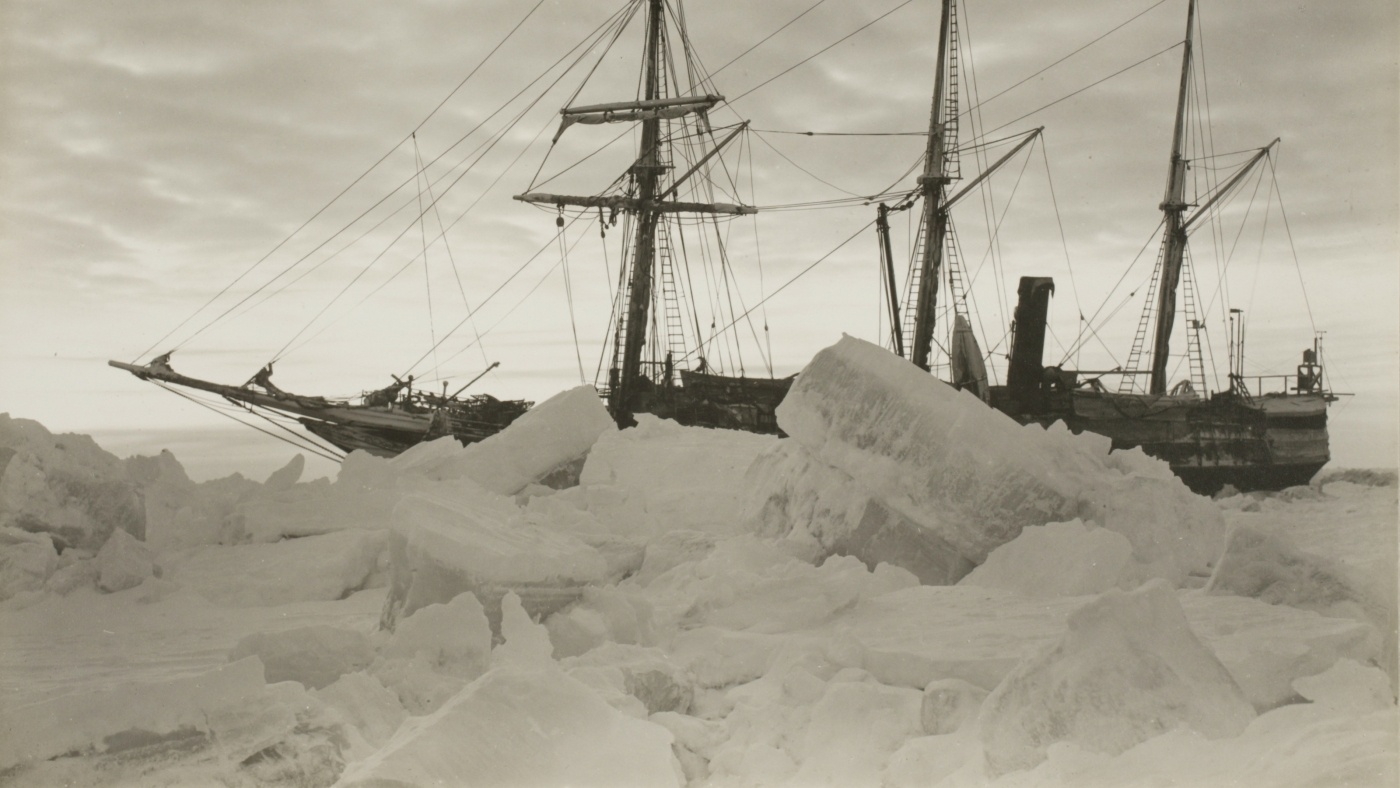

Endurance is proven within the winter of 1915. The ship grew to become caught in ice and finally sank. A brand new paper says it wasn’t as well-built as beforehand believed.
Frank Hurley/Scott Polar Analysis Institute, College of Cambridge by way of Getty Photos
cover caption
toggle caption
Frank Hurley/Scott Polar Analysis Institute, College of Cambridge by way of Getty Photos
What if some of the well-known and formidable Antarctic exploration vessels in historical past, whose crew’s story of shipwreck and survival has been advised for greater than a century, wasn’t as sturdy as legend had it?
A brand new research paper in regards to the vessel Endurance casts doubt on some frequent beliefs about explorer Ernest Shackleton’s ship, notably that it was some of the well-built ships of its period and that it went down because of the lack of its rudder after changing into trapped in sea ice in 1915.
“Neither of that’s true,” mentioned Jukka Tuhkuri, who wrote the paper and is a professor at Aalto College in Finland, the place he research sea ice and arctic marine expertise. “It was not a powerful ship in comparison with different ships of its time, and it didn’t sink due to the rudder.”

Tuhkuri carried out ice science analysis aboard the 2022 expedition that situated the wreckage of Endurance. The journey obtained him interested in why the ship sank. He spent the intervening years conducting a technical evaluation and brushing by historic information, together with drawings of the ship, pictures and private letters.
His paper, printed Monday within the journal Polar Record, argues that Endurance had a number of structural shortcomings that made it ill-suited for the icy circumstances of polar exploration and that Shackleton was conscious of its weaknesses.
Shackleton alluded to the ship’s deficiencies in a letter to his spouse, the place he wrote that Endurance was “not as sturdy as [his earlier ship] Nimrod constructionally” and that he would “alternate her for the outdated Nimrod any day now apart from consolation.” Shackleton and his crew obtained inside 97 miles of the South Pole on the 1907-1909 Nimrod expedition.
Design flaws doomed Endurance, paper argues

Endurance within the Weddell Sea, close to Antarctica. The ship grew to become caught and was crushed by ice.
Mitchell Library, State Library of New South Wales
cover caption
toggle caption
Mitchell Library, State Library of New South Wales
In response to Tuhkuri, Endurance was initially named Polaris and was created for Arctic tourism earlier than Shackleton purchased it to make use of for polar exploration. The ship was constructed to face up to collisions with ice floes on the ice’s edge, the place polar bears may very well be discovered searching.
“However Shackleton took it into pack ice that places compressive hundreds on the hull,” Tuhkuri mentioned. “And that is a special kind of loading, and it requires totally different particulars within the hull, and people weren’t there.”

In 1914, Shackleton led an expedition of 27 males on two ships — Endurance and Aurora — to Antarctica with the purpose of traversing the continent on land. Shackleton and the crew of Endurance sailed to at least one finish, whereas Aurora went to the opposite.
However earlier than Endurance may attain the shore, it obtained snarled in dense sea ice in January 1915, leaving the ship and its crew stranded. The lads lived on the frozen ship within the Weddell Sea for months however have been finally pressured to desert it that October, taking lifeboats and a small quantity of provides. Endurance sank on Nov. 21, 1915. Shackleton and all members of the Endurance crew eventually made it to safety and survived. (All however three males from Aurora have been rescued.)
The ship was crushed by ice

Polar explorer Ernest Shackleton is pictured in New York in 1921. He led the expedition aboard Endurance in 1915.
AP/
cover caption
toggle caption
AP/
Sea ice just isn’t one flat piece of frozen water, in line with Tuhkuri, however relatively a “mosaic” of different-sized ice floes pushed round by wind and currents in “fixed, messy movement.” Endurance drifted in frozen ice for some time, however finally the altering instructions of the ice squeezed the ship and finally sank it, he mentioned.
Tuhkuri mentioned that Endurance had weaker pine deck beams and oak and pine frames than different comparable ships of the time. However sure design decisions additionally made the ship’s hull weak, he mentioned. The lengthy machine room weakened it, and the hull lacked diagonal help beams discovered on different polar exploration vessels.

Tuhkuri additionally famous that whereas harm to the rudder sprung a leak within the ship, crew members have been capable of preserve it underneath management; the extra important harm to Endurance was the “tearing of the keel [the structural backbone running along the bottom of the ship], which broke the ship into two halves,” he wrote.
Tuhkuri mentioned he does not wish to detract from the legacy of Shackleton’s voyage however, relatively, add a brand new element to the historic report.
As he writes towards the tip of his paper: “Possibly Endurance was a powerful and heroic ship in a poetic sense; in an engineering sense, sadly, it was not.”
